Hard, smooth and non-absorbent
Paper takes ink because it is porous. Glass and glazed ceramic take nothing. Whatever goes onto a mug, a tumbler, a tile or a coaster has to either sit on the surface and be cured there, or be fused into the glaze with heat. That single fact explains every method on this page, why some of them wash off and others survive a decade of dishwashers, and why a print shop will ask what the item is for before quoting.
This guide covers the four practical ways to print on glass and ceramics, which one fits which product and quantity, and how to set up artwork that survives the process.
The four methods
Dye sublimation
The item is bought pre-coated with a clear polyester layer. Artwork is printed in reverse onto transfer paper with sublimation ink, wrapped tightly against the item, and heated to around 200 degrees C in a mug press or oven. The ink turns to gas and bonds into the coating. Result: full-colour photographic print with no raised edge, dishwasher-safe on the better coatings.
Limits: only works on coated blanks, so the range of shapes is whatever the blank suppliers stock (standard mugs, some tumblers, tiles, coasters, slate). White or light-coloured items only, because sublimation ink is transparent and has no white. Quantity from 1 upward, which is why this is the method for personalised photo mugs.
Screen printing (organic or ceramic inks)
Ink is pushed through a stencil directly onto the glass or ceramic. With organic (UV-cured or epoxy) inks, the print sits on the surface and is cured with light or heat; durable for promotional glassware but will eventually scratch. With ceramic frit inks, the item is fired in a kiln at 550 to 600 degrees C and the ink fuses permanently into the glaze. This is how commercial branded pint glasses and restaurant crockery are made.
Limits: one colour per screen, so multi-colour designs cost more and need registration on a curved surface. Set-up is real money, so minimums of 50 to 100 pieces are normal. Photographic detail is not achievable; solid graphics and text print beautifully.
Direct UV printing
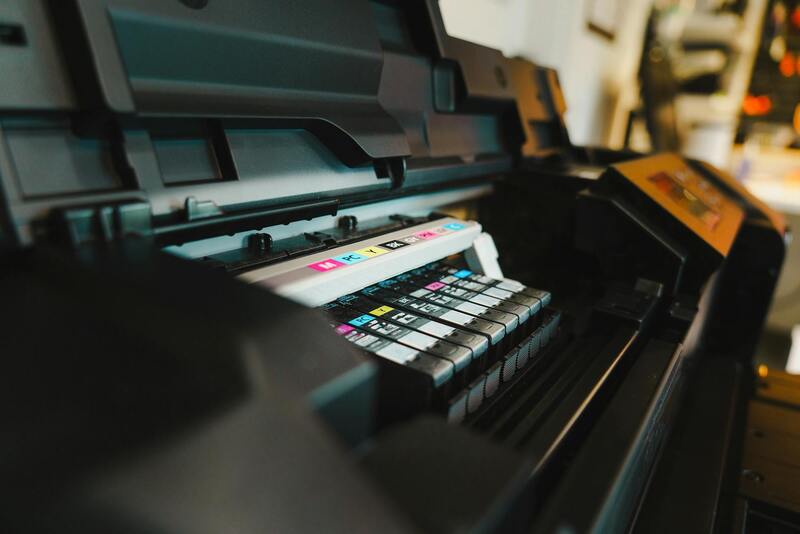
A flatbed or rotary UV inkjet prints straight onto the object and cures each pass with UV light. Full colour, white ink available (so dark glass and coloured ceramics work), any shape the printer can hold, no minimum. The print is a thin cured layer on the surface; with a primer it resists hand washing and handling well, but repeated dishwashing will wear it. Best for decorative pieces, awards, tiles that hang on a wall, low-volume branded items and anything with a photo on a dark or transparent surface.
Ceramic decals (waterslide transfers)
Artwork is screen printed or digitally printed with ceramic pigments onto decal paper, applied to the item by hand, then kiln fired to fuse. This is the route for full-colour designs that must be permanently fused, such as commemorative plates and hotel crockery. Quantity from about 20 upward; hand application means cost per piece stays higher than screen printing but the result is as permanent as it gets.
Matching method to product
| Product | Usual method | Why |
|---|---|---|
| Photo mug, 1 to 50 pieces | Sublimation | Full colour, no minimum, dishwasher-safe coating |
| Branded pint or wine glasses, 100 plus | Screen print, organic or ceramic ink | Low unit cost, crisp logos, permanent if fired |
| Black or coloured mug with logo | Direct UV with white underbase, or screen print | Sublimation cannot print on dark items |
| Ceramic tile for a wall or a sign | Sublimation on coated tile, or UV on plain tile | Not exposed to washing |
| Restaurant crockery with a crest | Ceramic decal or ceramic screen print | Must survive commercial dishwashers indefinitely |
| Glass award or plaque | Direct UV or laser engraving | One-off, detailed, dark background needs white |
| Coasters, sandstone or ceramic | Sublimation | Blanks are sold coated, colour is inside the surface |
Artwork for curved and rigid items
- Get the template. Every mug shape has its own printable area, usually a rectangle around 200 x 90 mm that wraps the body with a gap at the handle. Design inside the template, not on a mock-up.
- Keep important content away from the edges of the print area. On a wrap, the ends sit next to the handle and are partially hidden by it. On a tapered tumbler the top and bottom of the image distort.
- Vector artwork for screen printing, always. Each colour is separated to its own screen, and a raster logo cannot be separated cleanly. Our note on artwork for specialty substrates covers the general principle.
- Specify colours as Pantone for screen and decal work, and expect ceramic-fired colours to shift slightly (reds and oranges are the hardest to hold through a kiln).
- For sublimation, work in RGB at 300 ppi and remember that white areas of the design will be the colour of the blank, which is close to but not exactly paper white.
- Add a white layer for UV printing on dark or clear items. Supply it as a separate spot colour named "White" so the printer can lay it under the colour.
Durability, honestly
Ask the shop how the print is fixed, not whether it is "dishwasher safe". Fired ceramic ink and fired decals last as long as the item does. Sublimation into a good coating handles years of domestic dishwashing but fades if the mug lives in a sunny window. UV-cured surface prints and organic screen prints are hand-wash items; they are fine for a promotional glass that will be used at a launch and taken home, less fine for a cafe's daily-use cups. Neither is wrong, as long as the method matches the life the item will lead.
Printing on glass and ceramics with us
We print sublimation mugs, coasters and tiles from a single piece, screen print glassware and ceramics from 50 pieces with the option of kiln firing for permanent results, and run direct UV on flat or cylindrical items where a white base or a dark surface is involved. Tell us the product, the quantity and how it will be used, and we will recommend the method and send the correct template.
Samples matter more here than on paper, because the surface changes how colour looks. A single proof piece is always available before a run. Our print quality and materials page lists the substrates we handle, and for an item that is not a standard blank, send us a photo of it and we will confirm whether it can be printed and how.